Showing posts with label Iran. Show all posts

Wednesday, February 9, 2022

HALKBANK RECEIVES ADDITIONAL TIME TO FILE A PETITION WITH THE U.S. SUPREME COURT, ASSERTS CONFLICT CERTIORARI REGARDING THE CENTRAL LEGAL ISSUE


Attorneys for the Turkish Government-controlled HALKBANK (Turkiye Halk Bankasi) have requested an additional 59 days to file their Petition for a Writ of Certiorari with the Supreme Court of the United States. The Petition is currently due by March 15, 2022; the bank is asking for an extension to May 15.

 The bank's efforts to stop the criminal action pending against it, using the Foreign Sovereign Immunity Doctrine, which bars actions against foreign states, was unsuccessful, at both the District Court (SDNY) and appellate (2nd Circuit) levels. Both lower Federal courts held that the Commercial Activities Exception applied, and ruled that the case, which includes a money laundering count, could proceed.

Now, the bank's counsel is asserting that he has a trial in another case about to start in March, and the case is expected to take six weeks, with extensive pre-trial proceedings pending. He is also alleging that the Halkbank case presents very complex issues, which infers that the preparation of the petition will require a substantial amount of time.

The most interesting part of the Application for an Extension of Time is counsel's reference to Conflict Certiorari as the vehicle through which he apparently intends to be successful with the petition. When the decisions of two or more Federal appellate courts on the same issue are in direct conflict, the High Court can take jurisdiction to resolve the issue. Conflict Certiorari is a favored method of gaining access to the Court, but the conflict must be recognized  by the Court.

Generally, SCOTUS grants these applications for additional time. Halkbank's request was filed on January 24. The Court granted the request, extending the time to May 13, 2022; see the extract from the Sup Ct website below:

DateProceedings and Orders
Jan 25 2022Application (21A373) to extend the time to file a petition for a writ of certiorari from March 15, 2022 to May 13, 2022, submitted to Justice Sotomayor.

Main DocumentLower Court Orders/OpinionsProof of Service
Jan 31 2022Application (21A373) granted by Justice Sotomayor extending the time to file until May 13, 2022.

Sunday, January 9, 2022

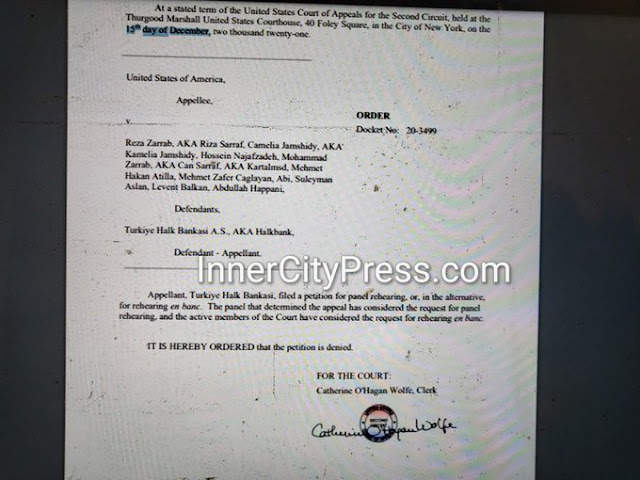
SECOND CIRCUIT DENIES HALKBANK'S MOTION FOR REHEARING OR EN BANC CONSIDERATION


Credit: Inner City Press


The Second Circuit Court of Appeals has denied, without opinion, the petition of Turkey's government-owned Halkbank (Turkiye Halk Bankasi) for rehearing of its recent decision allowing the criminal case pending in SDNY to move forward. The bank's counsel had  moved for a rehearing, or in the alternative, en banc consideration of its Sovereign Immunity defence. the 2nd Circuit held the case fell within an exception to the rule barring suits against foreign states.

The bank was seeking the dismissal of a pending case charging money laundering, IEEPA violations, bank fraud, and conspiracy counts, due to its ownership by the Government of Turkey. The Second Circuit decision has not, as of this writing, (9 January) been the subject of a Petition for a Writ of Certiorari to the United States Supreme Court, but it may still be filed before the deadline, being that it is a case many observers believe to be of great public importance, as it deal with evasion of US sanctions against Iran.

A check of the District Court docket today failed to reveal any post-appellate decision movement on the part of the US Attorney's office in New York; they may be waiting to see if a SCOTUS petition will be filed timely.  Considering that the primary defendant, REZA ZARRAB a/k/a Risa Sarraf, is a Cooperating individual, and he was the primary contact at the bank, the Government most likely has a strong case to bring to trial.

Saturday, January 8, 2022

STANDBY LETTERS OF CREDIT ARE NOT WHAT THEY APPEAR TO BE


We have been warning the financial industry about the dangers of seeking to obtain a Standby Letter of Credit for decades, but we still see legitimate businessmen paying huge fees to secure one for a major transaction, and always experiencing a loss as the direct result. For the benefit of those who are not familiar with the term, a Standby Letter of Credit is defined as a legal document that guarantees a bank's commitment of payment to a party, in the event that the other party defaults on an agreement. Basically, it is paid when certain conditions have not been fulfilled. An SBLC functions as a guarantee of payment.
 
It is distinguished from an Irrevocable Letter of Credit, which is a guarantee of payment when certain specified conditions are met, and supporting documents are received by the bank.
 
Here's the problem; it is literally impossible to fulfill all the terms and conditions of an SBLC within the time frame required in the document. Victims who pay an obscene amount of money to obtain one find, to their dismay, that they cannot sufficiently comply with the complex terms in a timely manner. therefore, the SBLC becomes useless, and the desperately needed funds promised in the SBLC are never paid out by the bank.  Many financial crime experts point out that an SBLC is truly a license to steal; it will never be paid to those who purchase them in good faith. Those who offer SBLCs to the financial community know very well that their clients will never collect the funds offered by the financial instruments they sell. Banks are free to offer SBLCs without fear of regulatory action against them, because so long as the buyer knows what the requirements for payout are, they are legitimate financial products, it's just that you can't collect.

 Caveat Emptor, please, with SBLCs.
We have a report, from reliable sources, that some SBLCs are allegedly being offered to Iran, purportedly to help them evade international and US sanctions.


Monday, November 8, 2021

WILL FINCEN SANCTION MALTA'S MAIN LEADING BANK ?


All of Malta has been in a uproar, in the aftermath of the disclosure that the country's disgraced former Prime Minister, Joseph Muscat, received "consultancy payments" from a Swiss shell company, paid by a mysterious Pakistani lawyer. Most observers have correctly concluded that the payments, which were obviously structured to conceal their true nature, were part of a corrupt arrangement between Muscat and a foreign company that concluded an extremely favourable arrangement with Malta in a major transaction.

The suspicious nature of the payments, and the PEP status of the recipient, newly out of office, and who flatly denied receiving any money when queried by the press, on camera, all add up to one more episode of compliance malpractice, on the part of the Republic of Malta's leading financial institution, which has been implicated in one suspected money laundering operation after another, during the past seven years that the Labour Party has been in office.  

None of this has escaped the attention of the Financial Crimes Enforcement Network (FinCEN),  as the United States maintains a zero tolerance policy for wilful violations of the Foreign Corrupt Practises Act, especially where US Dollars are involved, which invoke American jurisdiction over the offenders. Add money laundering to the FCPA, and you have a perfect storm, which greatly increases the probability that FinCEN with sanction the offending bank.

Bankers know that a FinCEN sanction usually operated as a fatal blow to a foreign financial institution, as it is then completely cut off from the American financial structure, due to the risk posed to any global bank that deal with it. Look at the end result when the Latvian Bank ABLV was sanctioned; utter collapse occurred. 


                                             Rubble, rubble, boil & trouble  by COSIMO


Some financial observers fear that Malta's economy could self-destruct if its leading bank was sanctioned by American regulators. Indigenous banks would not be able to take over the traffic, and local branches of foreign banks would decline the dodgy customers forced to flee to their doors. 

What is to be done, then,  bring in outside compliance talent, who could not be bought or bribed, to clean up the mess ? Experts from outside the European Union, with former law enforcement or regulators to advise, would be far more effective than the captive accounting firms from Malta, who like to overcharge, and rarely achieve the desired results. Clean up the bank or close it down, ladies & gentlemen. The money laundering facilitation has to stop.